One platform
where every dollar distributes.number reconciles, every lease performs, every deal closes, every dollar distributes.
Property operations, capital-markets brokerage, and investment management on a single source of truth — then a workspace shaped to every seat on your team.
Append-only hash-chained ledger · maker-checker approvals · export everything, anytime

One unified ecosystem, three layers deep.
Bridge property-level data and boardroom-level strategy — vertically integrated on one data model.
Operations
High-density property management built for the field and the front office — not a residential app with commercial patches.
- Dynamic rent roll & stacking plans
- CAM/NNN reconciliation & true-ups
- Work orders, turns & preventive maintenance
- Owner & tenant portals
Brokerage
Capitalize on market velocity with deal and transaction management built for CRE professionals.
- Deal pipeline (all rep types)
- Lease & sale comps database
- Commissions & splits
Investment
Model fund economics with data flowing automatically from real-time operations.
- Distribution waterfalls & IRR/TVPI
- Capital calls, LP statements & K-1 packages
- Debt schedules & DSCR
The same product you get in the demo — at work.
Watch a dollar reconcile
A charge is billed, a payment is matched, the ledger posts — and the dashboard figure moves in the same breath, because it reads the same rows. No sync, no export, no end-of-month surprise.
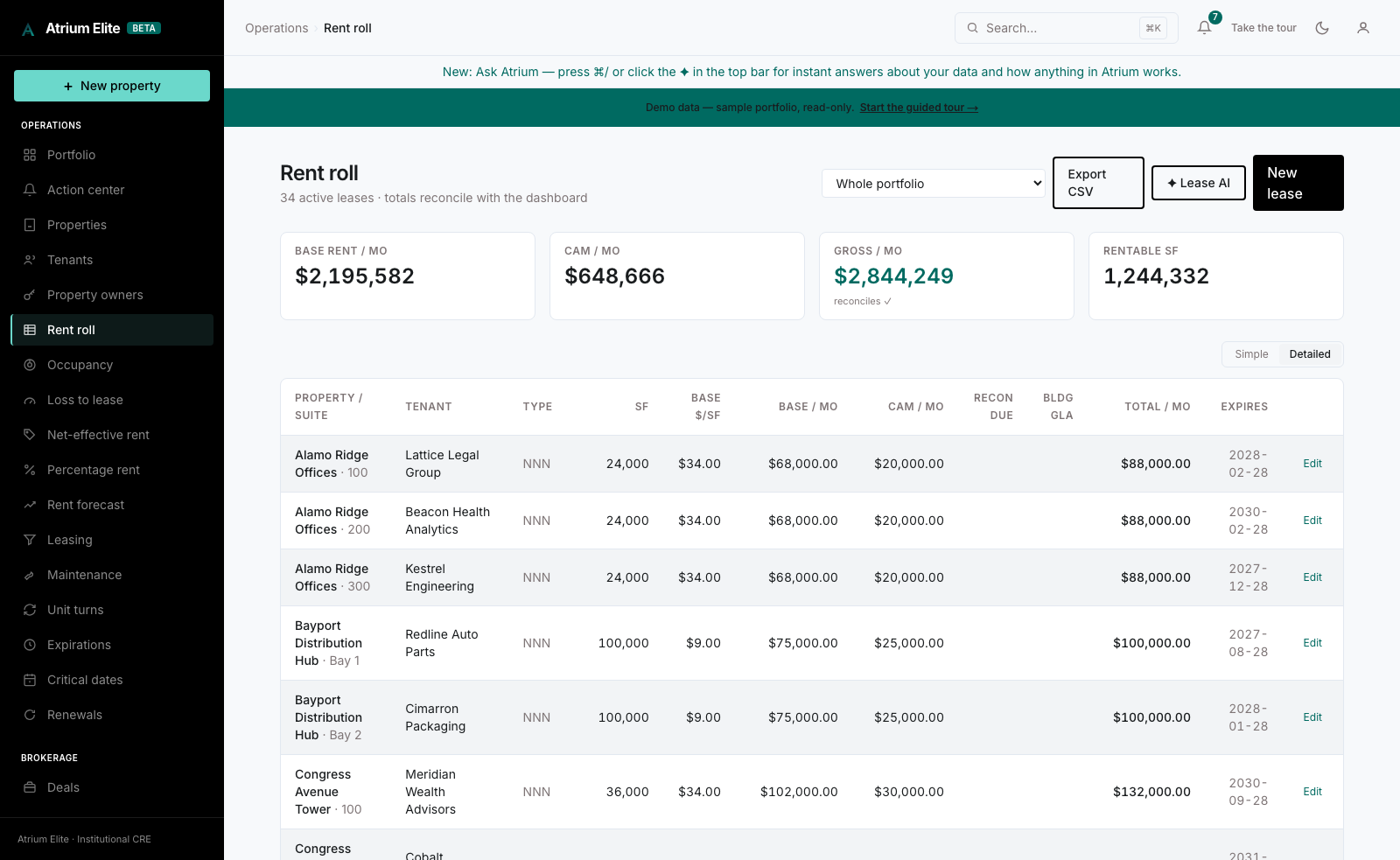
A rent roll that reconciles by construction
Every lease, suite, and escalation in one dynamic rent roll. Footer totals derive from the same rows the dashboard reads — the numbers agree because they are the same numbers.
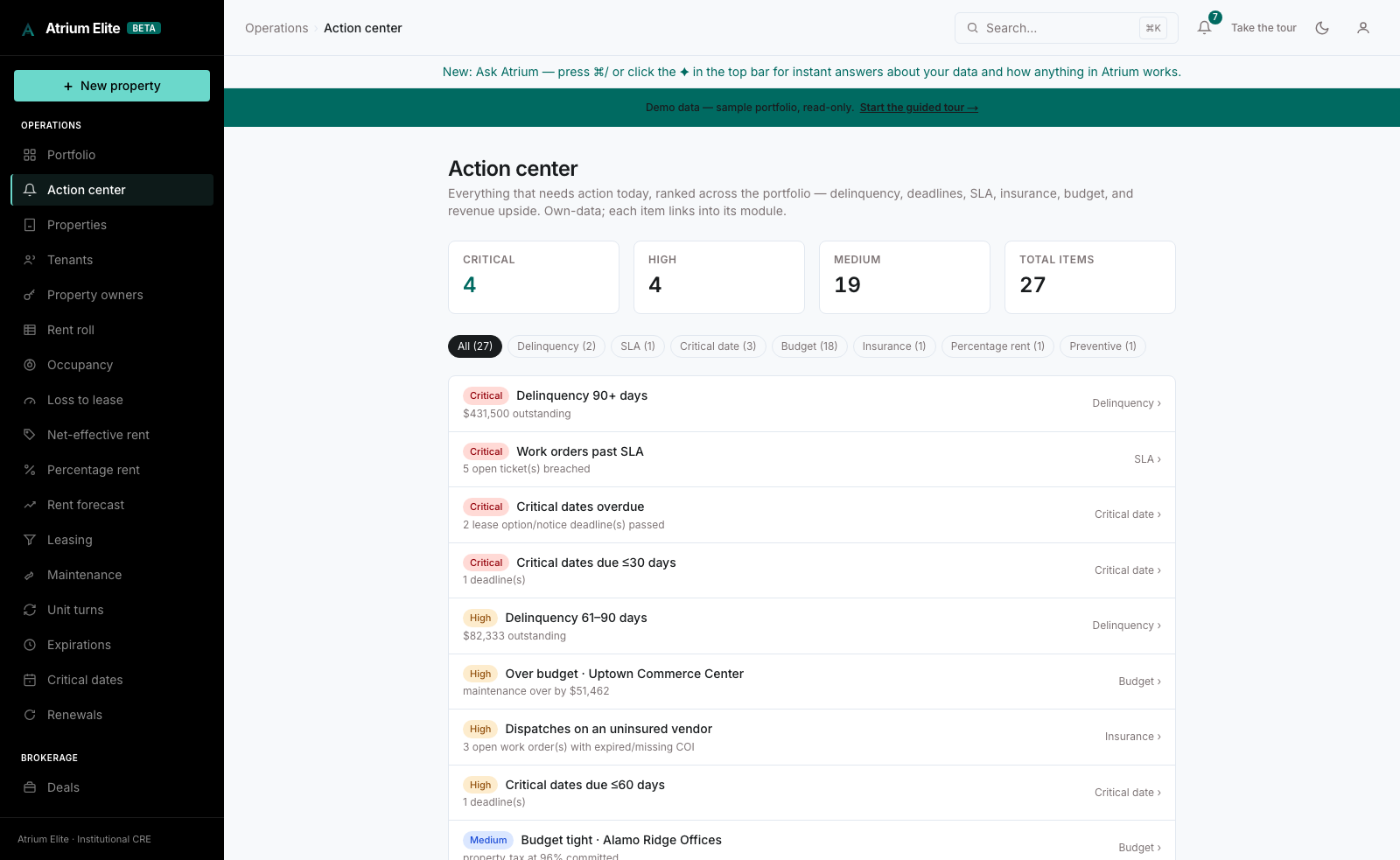
A portfolio that ranks what needs you
The action center scores delinquency, deadlines, insurance, and budget risk across every property — while the portfolio dashboard highlights the laggard and heat-maps work-order volume so problems surface before the month-end report.
Fund economics on live operating data
Distribution waterfalls, net IRR, TVPI, and GP/LP allocations computed from the portfolio underneath them — and Atrium flags when reported NAV drifts from the equity it can actually see.

A workspace for every seat.
Pick what someone does and Atrium shapes itself around them: a short nav of just their tools, a dashboard of the charts their role actually reads, and write access scoped to the areas they own. The full platform stays one tab away.
Accounting
The books: GL, close, reporting
Payables
Bills in, approvals, pay runs
Portfolio
Runs several properties end to end
Leasing
Pipeline, renewals, comps, commissions
Assets
Valuations, debt, capital planning
Investors
LPs, closes, distributions, K-1 season
Maintenance
Work orders and turns, phone-first
Audit
Read everything, change nothing, export evidence
Personas shape the experience; security stays separate — roles and per-area write scopes are enforced server-side, and an auditor seat can read everything while changing nothing.
Accounting deep enough to close on.
Atrium isn’t a dashboard bolted onto someone else’s ledger. Billing, collections, payables, payroll, budgets, and job costs post to the same append-only ledger the dashboards read — so the close is a review, not a reconstruction.
Governance is built in: maker-checker approval above your threshold, per-member write scopes, and a complete audit trail on every change.
- Automated rent billing, late fees & dunning
- Cash application & delinquency worklist
- AP approvals, pay runs, vendor master & 1099s
- Payroll runs with property-level labor allocation
- Budgets, reforecasts, commitments & variance
- Job costing as a ledger dimension
- CAM reconciliation & true-ups
- Monthly owner statements & K-1 packages
- QuickBooks Online export (GL + AP)
- Append-only, hash-chained ledger
AI that reads the operation — with an off switch.
Atrium’s AI works from your own portfolio data, and its suggestions land as drafts you approve — it narrates the numbers, it doesn’t invent them.
Operating review
A written monthly narrative of variances, delinquency movement, and expiring risk — grounded in the same reconciled figures on the page.
Lease abstraction
Drop in a lease PDF and get structured terms — rent steps, options, critical dates — staged for your review before anything is saved.
Bill entry
Invoices become coded draft bills in the AP queue — including PDFs your vendors email straight to Atrium. One account-level switch turns every AI feature off.
Bring your own AI
Connect Claude — or any MCP-compatible assistant — straight to your portfolio. Self-serve tokens, read-only, expiring, revocable in one click.
One workspace. Zero silos.
Legacy systems force you to toggle between separate accounting, leasing, and asset-management tools. That fragmentation creates data lag — the gap between something happening and you seeing it. Atrium sits on one data model, so a lease signed in operations flows up to the fund waterfall instantly.
Numbers that reconcile
Rent roll, financials, and dashboards derive from one source — they agree by construction, not by manual cross-check.
Automated governance
Every entry is validated before it lands, and posts to an append-only ledger — so the books stay provable.
Built for institutional trust.
Provable, audit-ready books
Every transaction is written to a hash-chained, append-only ledger — tamper-evident by design. Move from quarterly reconciliation to continuous verification.
Access shaped to each person
Roles set what someone may do; write scopes narrow it to the areas they own; maker-checker puts a second set of eyes on anything above your threshold. All enforced server-side.
No lock-in — your data stays yours
Export your entire account — every ledger, lease, bill, and investor record — to standard CSV anytime, free, in one click. You can leave whenever you want and take everything with you. It’s our published Data Portability Commitment, not a maybe — and none of the incumbents we’ve evaluated offers it.
Encryption at rest, audit logging, and least-privilege access built into the infrastructure.
Ready for institutional precision?
Stop managing by exception. See Atrium run a full commercial portfolio — or put it against your own rent roll.